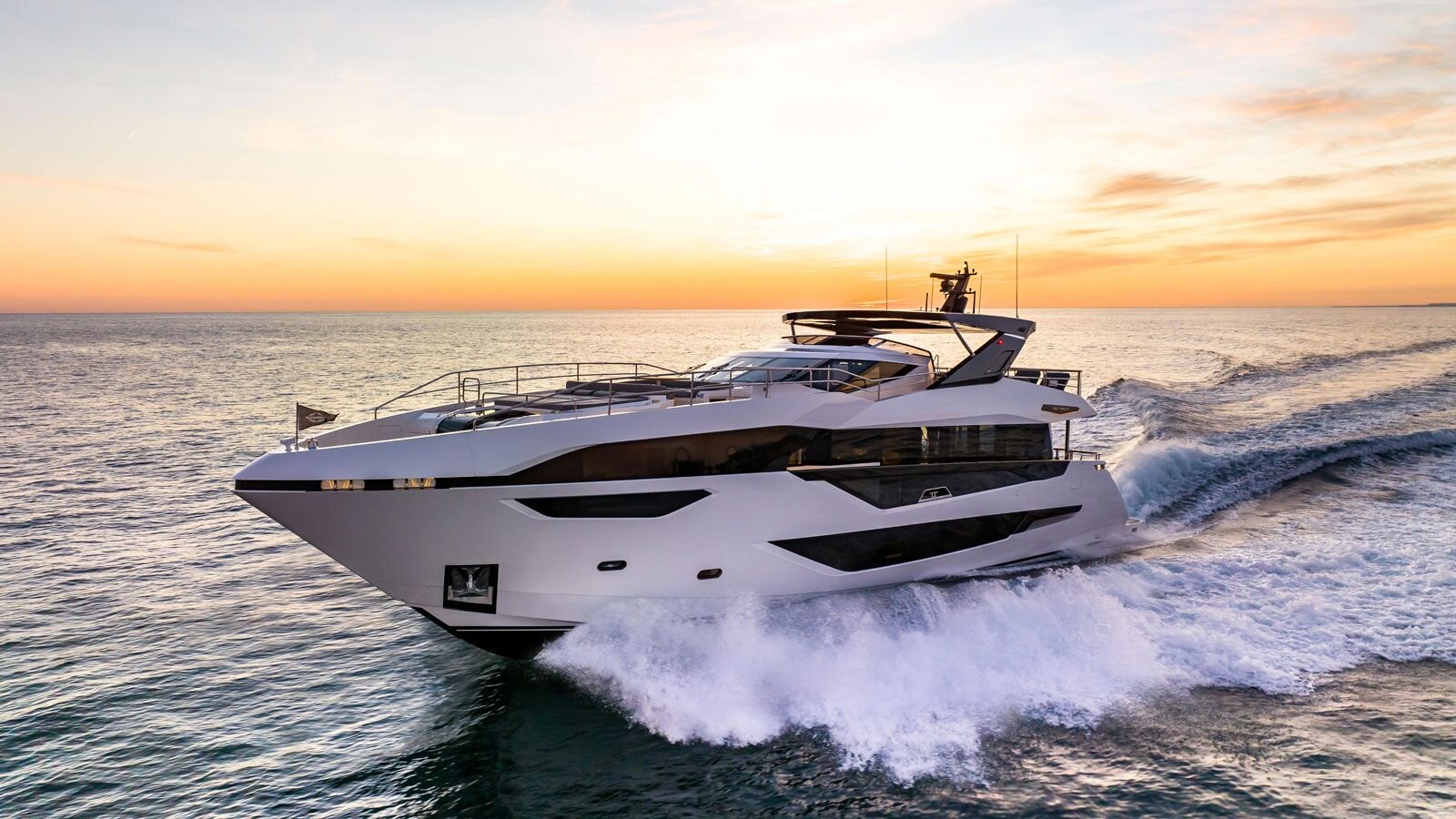
For anyone commissioning, buying, or surveying a large yacht or superyacht, hull material isn't a footnote — it's one of the handful of decisions that defines the boat. This guide compares the four materials used in modern yacht construction, their real pros and cons, and the builders and models best known for each, so the tradeoffs are clear before you're standing on a boat show deck.
Quick Answer: Hull Materials at a Glance
| Material | Weight | Build Cost | Corrosion | Impact Resistance | Best For |
|---|---|---|---|---|---|
| Steel | Heaviest | Lowest per kg (labor-intensive) | Needs coating & upkeep | Excellent | Explorer & expedition superyachts |
| Aluminum | Light | High | Naturally resistant* | Good (dents, doesn't shatter) | Fast & custom superyachts |
| GRP / Fiberglass | Light | Lowest (at scale) | None (not a metal) | Moderate | Production motor yachts |
| Carbon Fiber | Lightest | Highest | None (not a metal) | Stiff, but brittle on hard impact | Performance sailing superyachts |
- Weight
- Heaviest
- Build Cost
- Lowest per kg (labor-intensive)
- Corrosion
- Needs coating & upkeep
- Impact Resistance
- Excellent
- Best For
- Explorer & expedition superyachts
- Weight
- Light
- Build Cost
- High
- Corrosion
- Naturally resistant*
- Impact Resistance
- Good (dents, doesn't shatter)
- Best For
- Fast & custom superyachts
- Weight
- Light
- Build Cost
- Lowest (at scale)
- Corrosion
- None (not a metal)
- Impact Resistance
- Moderate
- Best For
- Production motor yachts
- Weight
- Lightest
- Build Cost
- Highest
- Corrosion
- None (not a metal)
- Impact Resistance
- Stiff, but brittle on hard impact
- Best For
- Performance sailing superyachts
*Aluminum resists rust the way steel does, but requires anodes and careful isolation from dissimilar metals to prevent galvanic corrosion in seawater.
Why Hull Material Shapes the Entire Yacht
Every hull material sits somewhere on the same trade-off curve: strength versus weight versus cost. A material that's stronger for its weight tends to cost more to build with and repair; a material that's cheap to mold at scale tends to give up some impact resistance to get there. Naval architects don't chase one "best" material — they pick the one whose trade-offs match how the yacht will actually be used.
That's also why the largest superyachts rarely use a single material at all. It's standard practice to build the hull in one material and the superstructure — everything above the main deck — in a lighter one, getting strength where it's needed most and weight savings everywhere else. More on that combination below.
Steel
Steel has been the backbone of large-yacht construction for over a century, and it remains the default choice for full-displacement superyachts built to cross oceans and, in some cases, push into ice. Plates are cut, rolled, and welded into a hull that can absorb a serious impact — a dock strike, floating debris, even light ice — without a catastrophic breach.
Pros
- Best impact and collision resistance of any common hull material
- Lowest raw material cost, with a mature global supply chain
- Can be repaired or modified at most shipyards worldwide
- Excellent for ice-class and polar expedition certification
Cons
- Heaviest material, which increases fuel burn and reduces top speed
- Requires ongoing corrosion protection: coatings, cathodic protection, and inspection
- Adds weight high in the structure unless paired with a lighter superstructure
- Impractical below roughly 30 meters, where the weight penalty outweighs the benefits
Best for
Full-displacement explorer and expedition superyachts, and any owner planning genuine long-range, open-ocean, or high-latitude cruising.
Popular builders & examples
The traditional hull material for large builders like Feadship, Lürssen, Oceanco, and Amels, almost always paired with a lighter alloy superstructure above the main deck.
Aluminum
Aluminum offers roughly a third of steel's weight for a comparable structure, without giving up much strength. It doesn't rust the way steel does — exposure to air forms a thin, self-healing oxide layer that protects the metal underneath — though it introduces its own corrosion risk when in electrical contact with dissimilar metals in seawater, which is why anodes and careful bonding are essential on an aluminum hull.
Pros
- Significantly lighter than steel for equivalent strength
- Higher achievable speed and better fuel efficiency than a steel hull of the same size
- Naturally corrosion-resistant when properly isolated from dissimilar metals
- Well suited to custom, one-off, and semi-custom builds
Cons
- More expensive to build than steel or GRP, welder-hour for welder-hour
- Prone to galvanic corrosion if not carefully managed with anodes and isolation
- Dents more readily than steel under a hard, concentrated impact
- Structural repairs require a yard with specialized aluminum-welding expertise
Best for
Fast-displacement and semi-custom superyachts where speed and range both matter, and explorer yachts that want steel-like toughness without steel's weight.
Popular builders & examples
Heesen Yachts built its reputation on all-aluminum, fast-displacement hulls — its 1988 build Octopussy once held the record as the world's fastest yacht at over 53 knots. Westport, CRN, and Rossinavi also build extensively in aluminum.
GRP / Fiberglass
GRP — glass-reinforced plastic, universally known as fiberglass — is woven glass fabric bonded in a resin matrix, molded into a hull shape and cured. It's the material that made production yachting possible: once a builder has a mold, hulls can be laid up repeatedly at a fraction of the labor cost of hand-welding steel or aluminum, which is why it dominates the market below roughly 40 meters.
Pros
- Lowest build cost at production scale, once the mold is tooled
- No corrosion to manage — it isn't a metal, so no anodes or galvanic concerns
- Lighter than steel and generally lower maintenance day-to-day
- Molds into complex curves and styling that metal fabrication can't easily match
Cons
- Less impact-resistant than steel or aluminum; a hard strike can crack or shatter the laminate
- Older or poorly built hulls can develop osmosis — water-driven blistering in the laminate
- Structural repairs require grinding back and re-laminating, which is skilled, unglamorous work
- Impractical to modify or extend the hull once the mold-based structure is set
Best for
Production and semi-custom motor yachts, sport cruisers, and virtually any build under roughly 40 meters where cost efficiency and low maintenance matter most.
Popular builders & examples
The standard material for Sunseeker, Princess, Azimut, Ferretti, Viking, and the great majority of Sanlorenzo's range below its steel and aluminum superyacht lines.
Carbon Fiber & Advanced Composites
Carbon fiber takes the fiberglass concept and replaces glass with woven carbon strands, which are dramatically stiffer and lighter for the same strength. It's the same material family used in Formula 1 chassis and racing sailboats, cured under heat and pressure in an autoclave for maximum strength-to-weight — a process that is precise, slow, and expensive.
Pros
- Best strength-to-weight ratio of any hull material by a wide margin
- Weight saved translates directly into speed, stability, and range under sail
- Extremely stiff, which improves structural rigidity and reduces flex at speed
- No corrosion, since it isn't a metal
Cons
- By far the most expensive material to build with, often several times GRP's cost
- Stiff but comparatively brittle — a sharp, concentrated impact can crack rather than dent
- Repairs require specialized composite technicians and autoclave-cured patches
- Limited network of yards worldwide with true structural carbon-repair capability
Best for
High-performance sailing superyachts and racing-derived designs where every kilogram saved improves speed, and where owners are prepared to pay a premium for it.
Popular builders & examples
Wally pioneered carbon-fiber construction on sailing superyachts and remains closely associated with it; Baltic Yachts builds many of its large custom sailing yachts in full carbon composite.
The Industry's Own Answer: Hybrid Construction
Above roughly 40–50 meters, most superyachts don't pick a single material at all — they combine two. A steel hull below the waterline handles the impact loads and rough water a large vessel takes over decades of service, while an aluminum superstructure above the main deck keeps weight and the center of gravity down, improving stability, speed, and fuel economy.
It's the same logic behind aluminum masts and carbon rigging on some larger cruising sailing yachts with a fiberglass hull: put the expensive, weight-saving material where the weight actually costs you something, and use a heavier, cheaper material where strength matters more than grams.
Choosing the Right Hull Material When Buying a Yacht
As with hull shape, there's no universally "correct" hull material — only the one that matches how the yacht will be used, crewed, and maintained.
Genuine long-range or high-latitude ocean cruising
a steel hull remains the benchmark for impact resistance and peace of mind offshore.
A fast, custom, or semi-custom build without steel's weight penalty
aluminum delivers steel-like durability at a fraction of the weight.
A production motor yacht with the lowest realistic cost and upkeep
GRP/fiberglass is the standard for a reason — it's proven, efficient, and low-maintenance.
A high-performance sailing yacht where speed under sail is the priority
carbon fiber's strength-to-weight advantage is difficult to match with any other material.
A large yacht that needs both offshore strength and reasonable speed
a hybrid build — steel hull, aluminum superstructure — is the industry's own answer to that exact tradeoff.
Hull material also affects the pool of surveyors, insurers, and future buyers who'll take the boat seriously — a well-documented maintenance history matters more for metal hulls, while a clean osmosis survey matters more for GRP. Either way, the paperwork is part of the value, not just the material itself. For how hull shape (rather than material) affects speed and comfort, see our guide to monohull yacht hull types.
Frequently Asked Questions
What is the strongest hull material for a superyacht?
Steel has the best impact and collision resistance of any common hull material, which is why it remains the standard for large expedition and explorer superyachts, and for vessels built to ice-class or polar certification. "Strongest" and "lightest" are different questions, though — carbon fiber has the best strength-to-weight ratio, even though a solid steel plate can absorb more raw impact energy.
Why do most large superyachts use a steel hull with an aluminum superstructure?
This hybrid approach is the industry standard above roughly 40–50 meters. The steel hull below the waterline provides strength and impact resistance where it matters most, while the lighter aluminum superstructure above reduces the yacht's overall weight and lowers its center of gravity, improving stability, speed, and fuel efficiency without sacrificing structural integrity.
Is aluminum or fiberglass better for a yacht?
Neither is universally better — they suit different build strategies. Aluminum is stronger, dents rather than shatters, and is well suited to custom or semi-custom builds and fast hulls, but costs more to build and repair. Fiberglass (GRP) is cheaper to mass-produce, needs less routine maintenance, and is the standard for production motor yachts, but is more easily damaged by a hard impact and harder to repair invisibly.
What hull material do most production motor yachts use?
GRP (fiberglass) is used for the overwhelming majority of production motor yachts up to roughly 40 meters, from brands like Sunseeker, Azimut, Princess, Ferretti, and Sanlorenzo's smaller models. It molds efficiently at scale, keeps build costs down, and needs no anti-corrosion maintenance.
Why is carbon fiber used on sailing superyachts?
Weight saved in the hull, deck, and rig of a sailing yacht translates directly into speed, stability, and the ability to carry a taller, more powerful rig. Carbon fiber offers the best strength-to-weight ratio of any hull material, which is why builders like Wally and Baltic Yachts pioneered its use on high-performance sailing superyachts, despite a build cost significantly above aluminum or GRP.
Does hull material affect a yacht's resale value?
Yes, in several ways. A well-maintained hull of any material holds value, but survey findings, maintenance history, and repair costs differ by material — GRP owners watch for osmosis, aluminum and steel owners watch for corrosion and anode wear, and any hard-impact repair history tends to draw closer scrutiny from surveyors and buyers regardless of material.
Can a damaged yacht hull be repaired, and does the material matter?
All four materials can be repaired, but the ease and cost vary widely. Steel and aluminum can be cut out and re-welded by a qualified yard, often restoring near-original strength. GRP requires grinding back and re-laminating the damaged area, which can be harder to make invisible. Carbon fiber repairs require specialized composite technicians and autoclave-cured patches, making them the most technical and costly to execute correctly.
What is the difference between GRP and fiberglass?
None — they're the same material. GRP (glass-reinforced plastic) is the technical, naval-architecture term; "fiberglass" is the common name for the identical material: woven glass fibers bonded in a resin matrix. Builders and surveyors use the two terms interchangeably.
Finding the Right Hull for Your Next Yacht
Hull material is one of the first questions worth answering before narrowing down a shortlist — it shapes everything from cruising range to survey outcomes to resale value years down the line. Whether you're weighing a steel-hulled explorer built for oceans or a fiberglass flybridge built for fast weekends on the water, the right material depends on your itinerary, your budget, and how the yacht will actually be used.
Biagio Yachts works with buyers and sellers across the Miami, Fort Lauderdale, and West Palm Beach markets, advising on exactly this kind of decision for both new and pre-owned vessels.