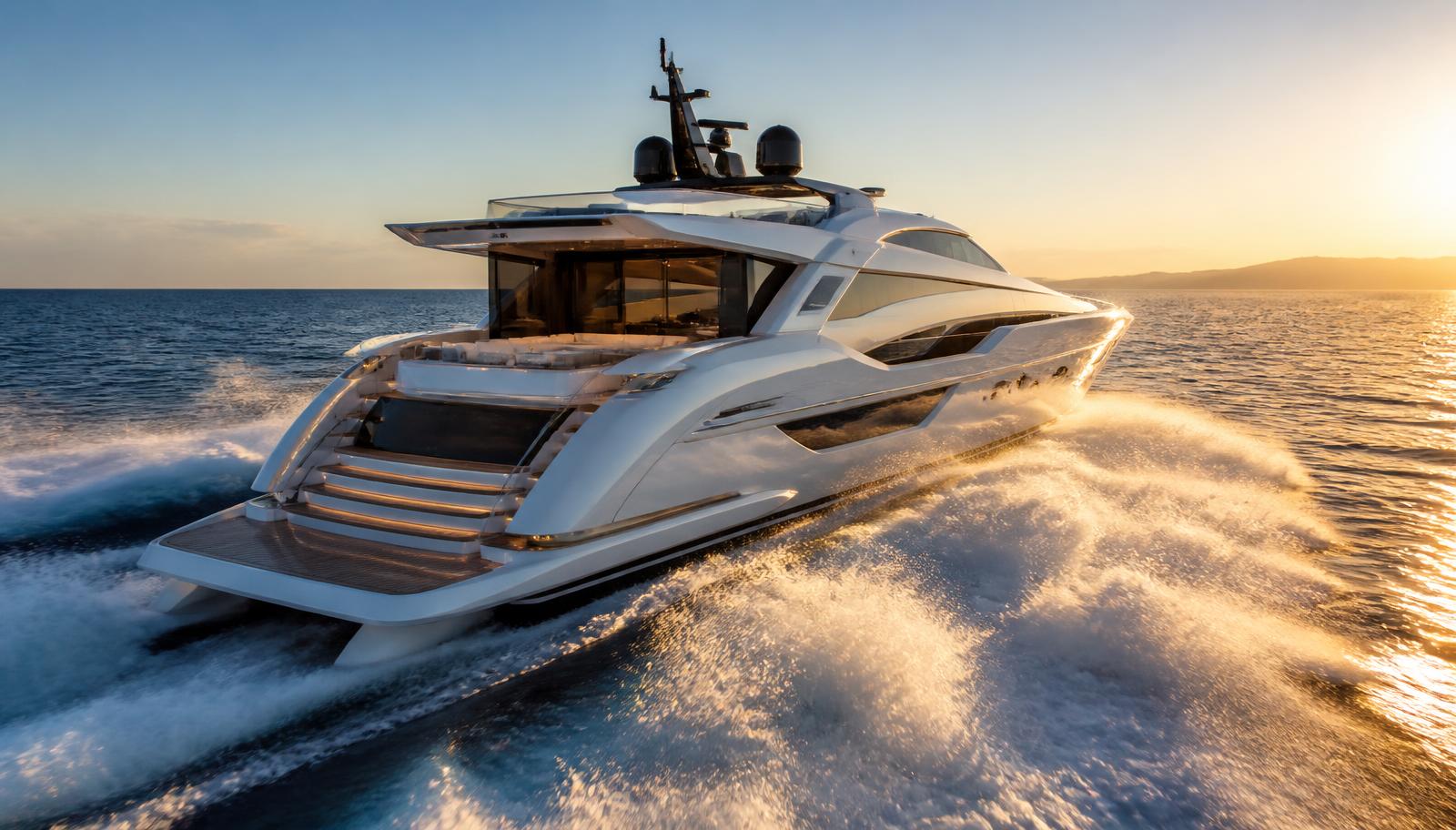
This guide walks through how each yacht drive system actually works, the major manufacturers behind them, and what each one means for ownership day to day.
Quick Answer: Yacht Drive Types at a Glance
| Drive Type | Running Draft | Best For | Service Network | Docking |
|---|---|---|---|---|
| Water Jets | Very shallow — nothing below the hull | Shallow-water cruising, tenders, chase boats | Jet-specialist technicians | Joystick control, excellent |
| Surface Drives | Shallow — props half-submerged | The fastest open and sport yachts | Specialized, alignment-sensitive | Demanding — rewards experience |
| Volvo Penta IPS | Pods hang below the hull | Flybridge & motor yachts ~40–100 ft | Authorized Volvo Penta centers | Joystick — easiest of all |
| Shaft Drives | Standard — shaft, strut & rudder | Reliability, range, anywhere service | Virtually any marine yard | Conventional (thrusters optional) |
- Running Draft
- Very shallow — nothing below the hull
- Best For
- Shallow-water cruising, tenders, chase boats
- Service Network
- Jet-specialist technicians
- Docking
- Joystick control, excellent
- Running Draft
- Shallow — props half-submerged
- Best For
- The fastest open and sport yachts
- Service Network
- Specialized, alignment-sensitive
- Docking
- Demanding — rewards experience
- Running Draft
- Pods hang below the hull
- Best For
- Flybridge & motor yachts ~40–100 ft
- Service Network
- Authorized Volvo Penta centers
- Docking
- Joystick — easiest of all
- Running Draft
- Standard — shaft, strut & rudder
- Best For
- Reliability, range, anywhere service
- Service Network
- Virtually any marine yard
- Docking
- Conventional (thrusters optional)
Water Jets
A water jet doesn't use a propeller at all. An impeller inside the hull draws water in through an intake on the bottom of the boat and forces it out through a steerable nozzle at the transom, and the reaction thrust pushes the boat forward. Steering and reverse are handled by deflecting that jet stream rather than turning a rudder.
Because there's no running gear hanging below the hull, jet-driven boats draw very little water and have nothing exposed to strike a sandbar, line, or piling. That makes them a natural fit for shallow-water cruising grounds and for tenders and chase boats that need to nose right up to a beach.
Hamilton Jet
Hamilton, out of New Zealand, is one of the most established names in waterjet propulsion, with decades of use in fast ferries, pilot boats, and search-and-rescue craft before becoming a common choice on performance and expedition yachts.
Rolls-Royce Kamewa
Kamewa jets built their reputation under the Rolls-Royce Marine name and are now produced by Kongsberg Maritime, which acquired Rolls-Royce's commercial marine division. Kamewa units are engineered to absorb very large horsepower loads, which is why they show up on large fast yachts and superyacht support/chase boats where high top-end speed matters.
The trade-off
Jets are exceptional at shallow draft and low-speed control via joystick, but they're less efficient than a propeller at normal cruising speed, and servicing an impeller and steering/reverse bucket assembly requires a technician familiar with that specific jet unit — not every yard can turn a wrench on one.
Surface Drives
A surface drive mounts the propeller shaft near-horizontal at the transom, so the propeller runs half-submerged, spinning partly in air and partly in water rather than fully underwater like a conventional shaft installation. Less of the running gear stays wetted, which cuts drag dramatically at speed — which is exactly why surface drives are the propulsion of choice on the fastest open and sport yachts on the water.
Arneson
Arneson Surface Drives, developed by Howard Arneson and produced in the U.S., is the system that essentially created this category and remains one of its best-known names.
Top System
Top System (Topsystem), an Italian manufacturer, is widely specified on high-performance Italian-built yachts, where surface drives are practically a signature feature of the segment.
The trade-off
Surface drives deliver serious top-end speed and a shallow running draft, but they reward — and really require — an experienced hand. Trim angle has to be actively managed, low-speed docking is less forgiving than a joystick pod boat, and the props sit exposed near the surface, more susceptible to debris and light strikes than a fully submerged shaft. Alignment is also more sensitive, which tends to mean more specialized (and less universally available) service.
Volvo Penta IPS (Pod Drives)
IPS — Inboard Performance System — replaces the traditional shaft-and-propeller with a pod mounted under the hull that steers by rotating, similar to an outboard, rather than by using a rudder. The propellers face forward and pull the boat through clean, undisturbed water instead of pushing through the turbulence behind the hull, which is the source of the system's efficiency gains, along with joystick maneuvering that lets the boat move sideways or spin in place at the dock.
How many pods a yacht carries depends on its size and power requirements:
Twin IPS
Two pods is the standard IPS configuration and the one most owners will encounter, typically on flybridge cruisers and motor yachts up to roughly the 60-foot range. Twin IPS delivers the core benefits of the system — joystick docking, strong fuel efficiency, low vibration — in the most straightforward, most widely serviced configuration IPS offers.
Triple IPS
A third, center pod is added on larger, heavier yachts that need more total thrust than twin pods can comfortably provide while still keeping IPS's efficiency and joystick advantages. The center pod also gives the system finer control at slow speed — useful on a heavier hull that's harder to pivot on two points alone.
Quad IPS
Four pods are reserved for the largest planing and semi-displacement motor yachts, generally 80 feet and up, that need four engines' worth of power. Quad IPS lets a yacht that size retain pod-style joystick handling and efficiency at a scale that, a decade ago, would have meant shaft drives by default.
The trade-off
IPS is genuinely excellent engineering — better fuel economy, quieter running, more usable interior volume since engines can sit further aft, and docking that's dramatically easier for an owner-operator. But the pods hang below the hull and are vulnerable to a hard grounding or a serious debris strike, and repairing one isn't a job for a general mechanic — it typically means a haul-out and an authorized Volvo Penta service center. Outside of warranty, that specialization tends to show up in the repair bill.
Shaft Drives
A shaft drive is the oldest and simplest architecture in the business: the engine turns a shaft that runs directly to a propeller, full stop. There are two common layouts.
Straight Shaft
The engine sits roughly amidships and the shaft runs aft at a slight angle to clear the hull, straight out to the propeller. It's essentially the same mechanical layout used on workboats and commercial vessels for the better part of a century, which is exactly why it's so easy to keep running.
V-Drive
A V-drive engine faces backward, mounted near the transom, driving forward into a gearbox that reverses the direction and sends the shaft back out and down to the propeller at an angle. This lets the builder push the engine room aft, freeing up cabin space amidships, while everything downstream of the gearbox is still a conventional, simple shaft-and-strut installation.
The trade-off
Shaft drives give up a little fuel efficiency compared to a well-matched IPS installation, and without a bow or stern thruster added separately, they don't offer joystick-style docking out of the box. What they give back is simplicity: there is no yard in Florida, the Bahamas, the Mediterranean, or almost anywhere boats go that can't service a shaft, cutless bearing, and strut. Parts are inexpensive, wear patterns are well understood, and every marine surveyor and lender knows exactly what they're looking at.
Bottom Line: What Should a First-Time Buyer Choose?
All four systems are legitimate engineering solutions, and each one earns its place on the right hull for the right use case — jets for shallow-draft cruising, surface drives for outright speed, IPS for fuel efficiency and effortless docking on the right size yacht. There's no wrong answer among them in the abstract.
But ownership is where the differences really show up, and for someone buying their first yacht, we'd gently steer toward keeping propulsion as simple as possible. A shaft drive — straight shaft or V-drive — is the option with the fewest surprises: it's mechanically straightforward, it's serviceable by virtually any qualified yard wherever you cruise, and the parts and labor costs are predictable rather than specialized. That combination tends to mean fewer headaches and more time on the water, which, for a first boat especially, is usually worth more than the last half-knot of top speed or the last percentage point of fuel economy.
If you're weighing these trade-offs against a specific yacht you're considering, that's exactly the kind of conversation we have with clients every day — happy to talk through what makes sense for how you actually plan to use the boat.
Frequently Asked Questions
What is the most reliable yacht propulsion system?
Shaft drives — straight shaft or V-drive — are generally considered the most reliable and easiest to maintain because the mechanical layout is simple, well understood, and serviceable by nearly any marine yard worldwide, rather than requiring a specialized technician.
Are Volvo Penta IPS pods reliable?
Yes, when properly maintained — IPS pods are engineered for strong reliability and deliver real advantages in fuel efficiency and low-speed handling. The main consideration is that repairs, especially after a grounding or debris strike, typically require an authorized Volvo Penta service center rather than a general mechanic.
What's the difference between a straight shaft and a V-drive?
Both drive a conventional propeller through a shaft. A straight shaft runs directly from a mid-mounted engine to the propeller. A V-drive uses a transom-mounted, rear-facing engine and a gearbox to reverse the direction of power, freeing up cabin space amidships while keeping the same simple shaft-and-strut running gear.
Do waterjet drives need less maintenance than propellers?
Not necessarily less — just different. Jets eliminate exposed running gear below the hull, which reduces the risk of prop or shaft damage, but the impeller and steering/reverse assembly require a technician experienced with that specific jet brand, which can mean a smaller service network than a conventional shaft.
Which yacht drive is best for a first-time buyer?
For most first-time buyers, a shaft drive — straight shaft or V-drive — is the simplest and lowest-maintenance choice, thanks to its mechanical simplicity and wide availability of qualified service almost anywhere you'll cruise.
Choosing the Right Drive for Your Next Yacht
Propulsion is one of the first questions worth answering before narrowing down a shortlist — and one of the areas where an experienced broker earns their fee, matching a drive system to how you'll actually use the boat rather than how it looks on the spec sheet.
Biagio Yachts is a luxury yacht brokerage serving buyers and sellers across Miami, Fort Lauderdale, and West Palm Beach. Contact us to talk through which propulsion system fits how you plan to use your next yacht.